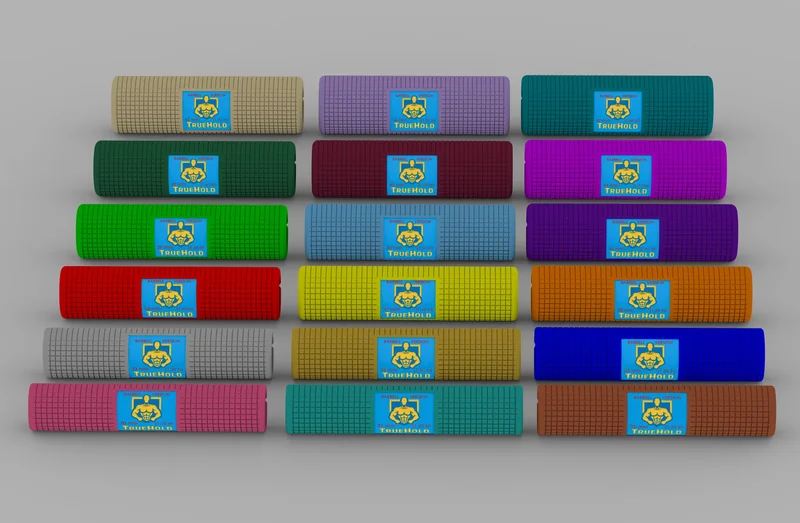
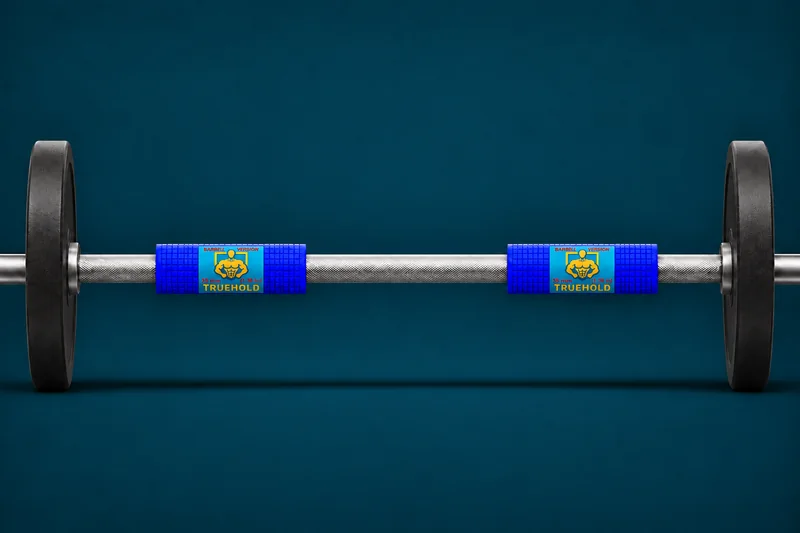
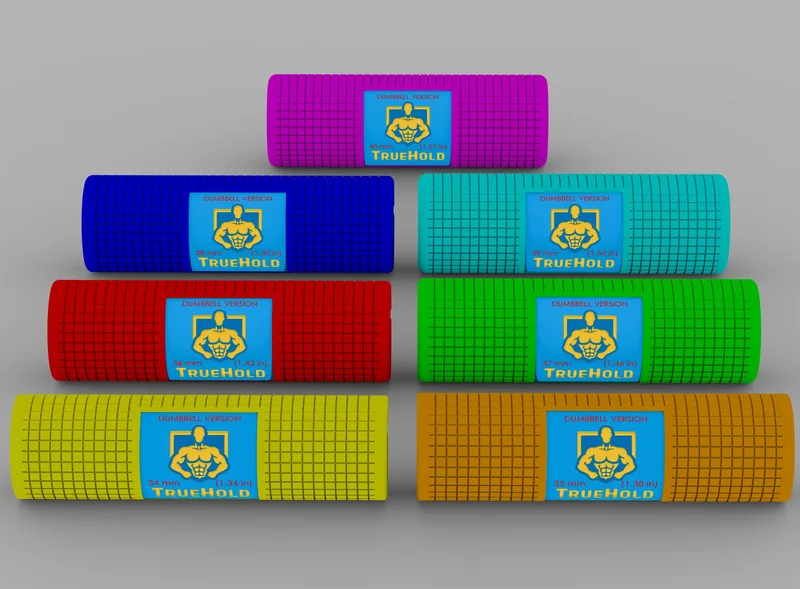
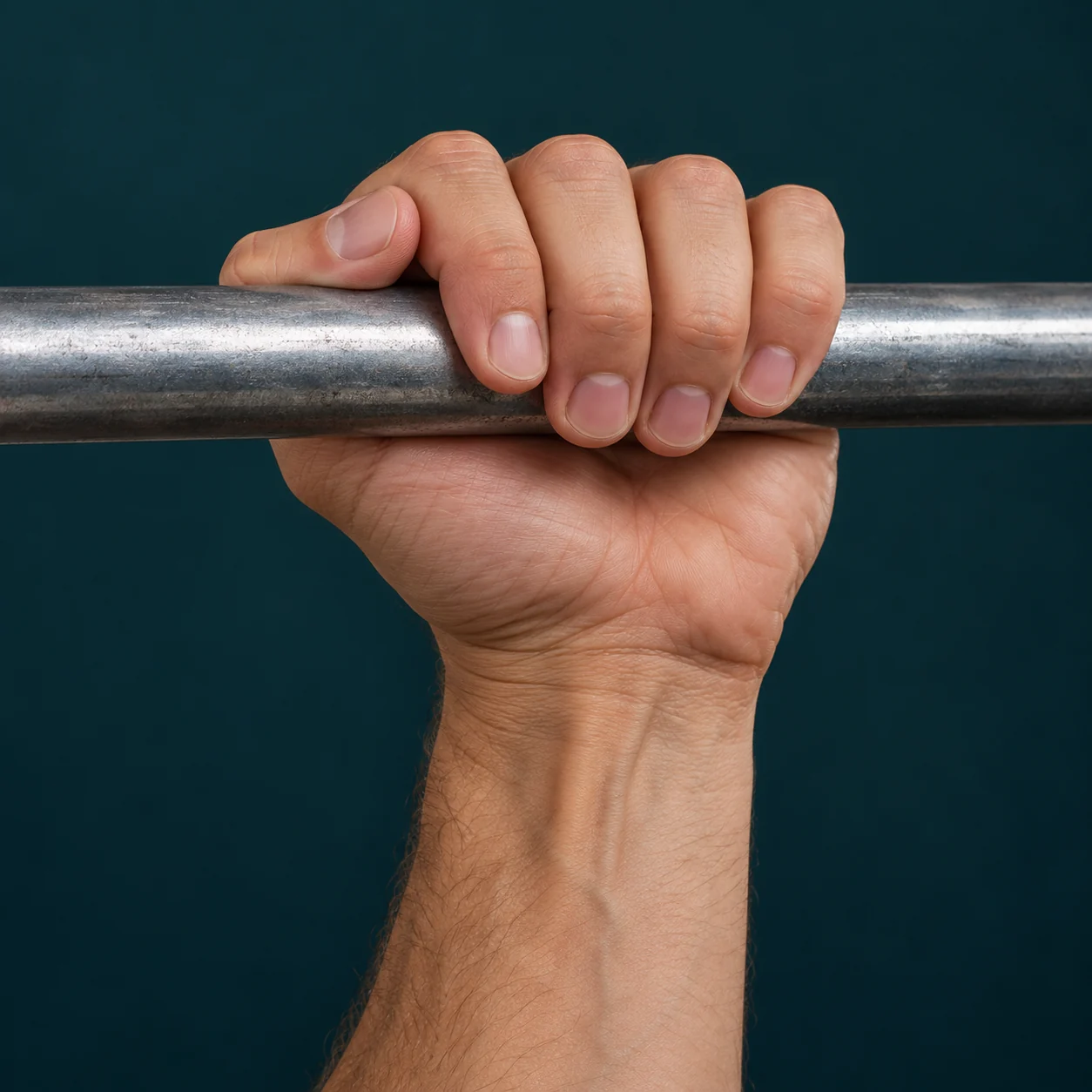
is the #1 upgrade in the fitness industry since the invention of the barbell.

Get yours

The Winning Edge - Why use TrueHold?

Correctly fitted TrueHold

Using only the standard bar (too small)

  • A millimeter-precise fit tailored to your hand

    Find your range, experiment with the neighboring sizes, and then pick your best. TrueHold can get you to within 0.5 millimeters of your perfect fit.

  • One diameter for many hands

    Generic for everybody is optimized for nobody. This is not the way to optimize performance.

  • Designed for optimal performance ⇒ Designed for PRs

    TrueHold is not a bit part accessory for the beginning or end of your workout. It is designed to maximize your power and reduce inefficient strain. It is for PR lifts. It is for endurance training. And it is for everything in between. We expect you to break your own records once you start using TrueHold.

  • Excessive clenching and unnecessary strain

    Smaller bars often result in excessive clenching of the hands and inefficient strain and tension.

  • Increased bar speed

    Training with your optimal diameter (one that is not too big nor too small) allows you to activate the extensor muscles of the hand and control the bar much more efficiently in the eccentric (negative) part of the rep, while also allowing you to accelerate through repetitions much more efficiently than with a thinner bar. (This is especially evident with very tall people who typically struggle with this aspect on standard thinner bars.)

  • Leaving acceleration power on the table

    For those without a severe mismatch to the standard bar, training with the optimal diameter will still give improvements, but they may be more subtle. However, taller guys who are 6'4", 6'5" or 6'6" and are not using TrueHold are almost certainly leaving a very significant amount of acceleration power on the table.

  • More complete hand and muscular engagement

    When training with your optimal diameter, your fingers, hands and forearms work together smoothly and naturally, allowing greater activation of the larger muscles, such as the lats, chest and shoulders.

  • A fixed diameter can feel less comfortable

    A fixed diameter can feel less comfortable and (to varying degrees) make it harder to activate the larger muscles of the body outside of the hands.

  • TrueHold allows for greater mobility alongside muscle and strength

    Training with the correct diameter enables the hand extensors to stay fully activated rather than collapsing around a thinner bar. This helps you stay open and mobile while building muscle, removing the mobility crutch of excessive clenching with collapsed extensors.

    Stretching and mobility work still matter and are still necessary. TrueHold merely removes a major restriction. It does not replace that work.

  • The thin bar collapses the extensor muscles of the hands

    The body closes off and compensates with excessive clenching for stability. These patterns pull the body out of alignment and can limit or inhibit mobility and flexibility work.

  • TrueHold gives you a winning edge versus those who continue like before

    Especially for those who use TrueHold from the start, while many are still training with any random diameter. This is where your progress in the gym will start to compound: the longer you train with your optimal diameter, the better your hand health will become, the greater the activation of your muscles, the greater your bar speed will be, and the more you will gain versus people who fail to adapt.

  • Continuing like before means falling behind

    People who continue like before, training with whatever diameter is given to them, will simply fall behind in the medium to long run versus people who have taken the time to optimize their tools.

What is your hand size?

What is your foot size?

We believe optimizing for your hand should be as basic and obvious as how you optimize for getting the right shoe size on your foot.

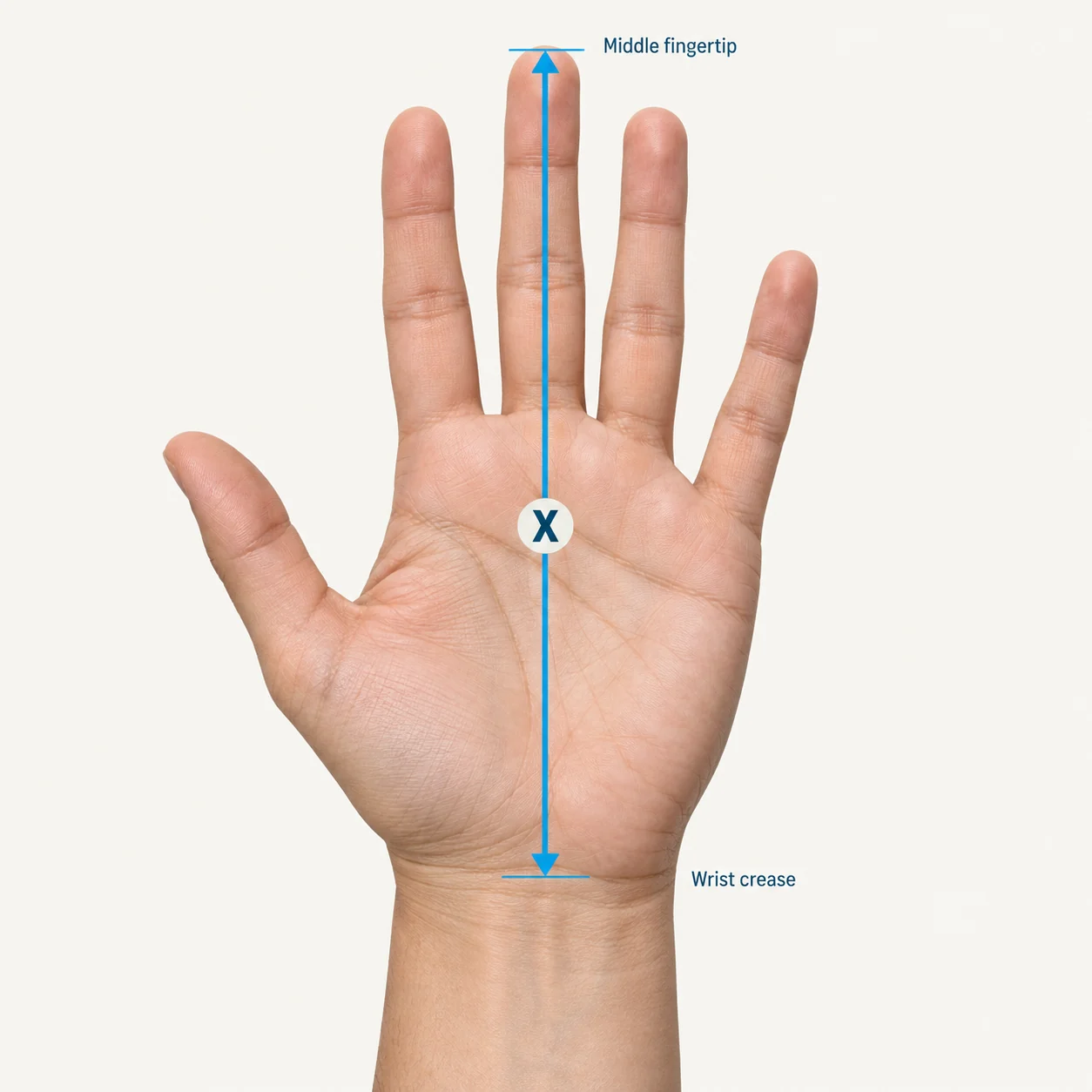
Open hand with a measurement arrow from the wrist crease to the tip of the middle finger

Measure the area marked in this photo, from the crease of your wrist to the tip of your middle finger.

Your hand length gives us a starting grip range. You will almost certainly need to compare neighbouring sizes to discover your best fit for peak performance.

Advanced Five Finger Grip Range Calculator

A.K.A. “FALSE GRIP”

With the thumb alongside the fingers.

For advanced practitioners, when using the correctly tailored diameter, the five finger grip can produce extraordinarily high quality muscular contraction and also be easier on your joints. The five finger grip has a slightly higher optimal diameter than is the case with the standard thumb in opposition grip.

Experienced gym-goers: use this calculator too when choosing models for false grip training.

Not for beginners.

Illustration of a false grip with the thumb alongside the fingers on a bar

Our Story

It started with my own hands

Being 6'6" myself, I've always had oversized hands versus the standard barbell, and I was simply trying to solve my own problem in my own bubble

This very quickly evolved into something I thought was an incredibly powerful niche

I thought would be mainly for very tall people: a super powerful transformative niche for people with large hands, ranging mainly from 6'2" to 6'6"+

Finally, revealed itself as a training tool to transform the entire male gym population, and a significant proportion of the female gym population too.

The more I researched, the more the data revealed that even the average sized male hand points to a significantly larger grip diameter than the standard 28 mm barbell. But to add to that even more, the data revealed that even the average female hand points to an optimal diameter greater than the 28 mm barbell, albeit to a slightly lesser degree, under the hand length relationship discussed below.

I discovered through random chance.

Background:

  • In 2021, while living in Australia, I started training regularly with Fat Gripz again, using their flagship model, the blue Fat Gripz Pro at 2.25 inches. They were clearly too large for my hands, but I still preferred the feel of a thicker handle versus the standard 28 mm bar. Pressing in particular felt better. (For full breakdown Vs Fat Gripz click here)
  • For years, as I went about my life with other goals, was an idea in the back of my mind, waiting to be unearthed. I kept thinking, if only these Fat Gripz were smaller. But how much smaller, I didn't know. Nor did I know how to go about making one, even if I wanted to.
  • Then in France in 2025, I discovered Fat Gripz had a smaller model, the Fat Gripz One at 1.75 inches. I thought maybe I had finally found the answer. Maybe 1.75 inches would fit me perfectly. It was closer, but still too large.
  • At the time, I was studying software engineering, randomly living in a remote rural area two hours south of Paris in France, and using AI as part of my coursework.
  • One day, while procrastinating on a coding assignment, I started asking AI different training questions, eventually leading to: what diameter should fit my hand? The answer appeared to be around 1.6 inches.
  • Initially, I only wanted to make one prototype for myself. Then, still avoiding the coding assignment, the obvious question arrived: If I needed a specific diameter, wouldn't lots of other people have the exact same need?

One model every millimetre.

The first range moved in 0.1-inch increments.

That wasn't accurate enough.

We reduced it to 0.05 inches, approximately 1.27 mm.

Eventually, we decided we wanted maximum efficiency and simplicity.

moved fully to metric: one model every millimetre.

This allows to fine-tune to within 0 - 0.5 mm of your perfect tailored fit.

For calculated diameters within the model range, one millimetre increments put the nearest model no more than 0.5 mm away. This describes size selection, not a manufacturing tolerance or a guaranteed performance optimum.

is ultimately about proportion.

is about giving more power and more control for less strain.

The larger the mismatch, the more there is to correct.

Larger hands generally get a higher net gain, simply because their mismatch is more severe with the standard bar.

However, is not only for unusually large hands.

is for any hand that does not have a perfect tailored match with the standard bar. And the reality is, few hands have won that precise lottery.
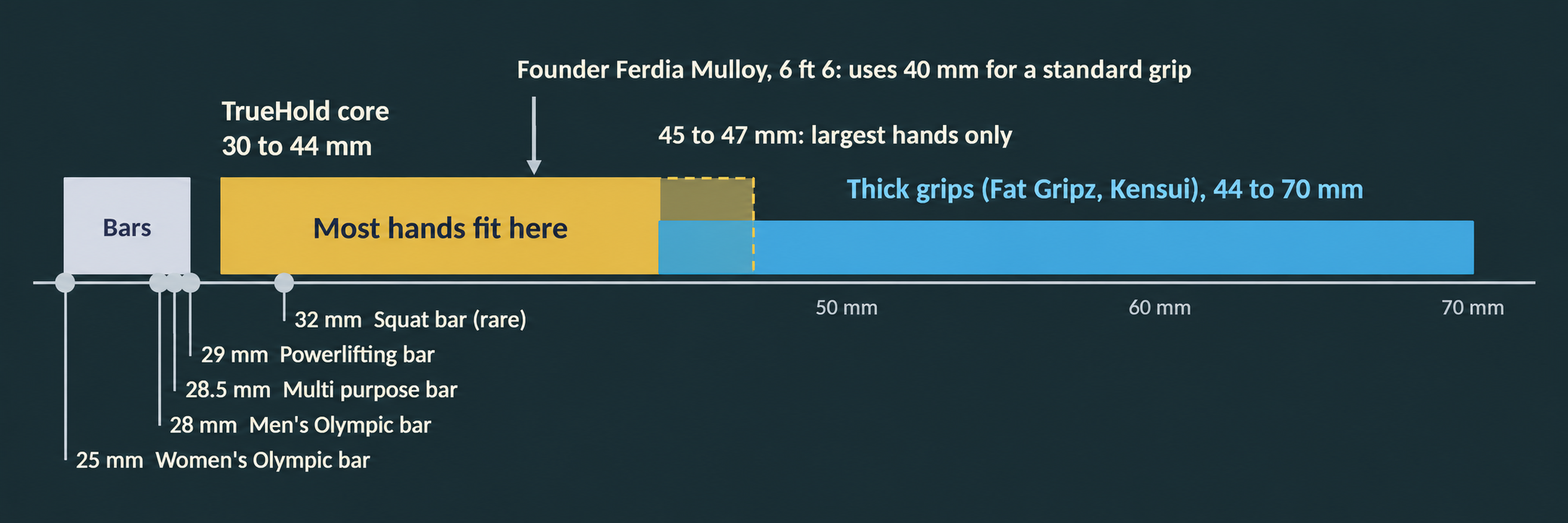
Fat Gripz and TrueHold: goals, sizing and training philosophy
ComparisonFat Gripz
Core goalDeliver a deliberately thicker handle to increase grip demand.Deliver the optimal fitted diameter so that you can produce maximal force across the body.
Current sizing3 diameters:
1.75 inches / 44.5 mm
2.25 inches / 57 mm
2.75 inches / 70 mm
18 barbell diameters:
30 - 47 mm, every 1 mm
Sizing progression philosophy?Yes. As your grip gets stronger, you can progress up the Fat Gripz models to test yourself even more.No. Your hand size is your hand size. Once you’ve got the correct size, you stick with that size and you get stronger at that size.
Designed to make gripping harder to improve grip strength?Yes.  But...

(Greater grip difficulty does not establish greater grip strength gains. Larger diameter and more strain with less total weight is not superior for grip strength versus optimal fit and maximal load.)

No, it’s designed to make it easier. Yet...

(Yet ironically, the available grip force data and founder observations point towards the hypothesis that fitted diameter training produces superior grip and forearm development. See the data below.)

Suitable for maximal strength PRs?No.Yes, when correctly fitted.
Designed around maximum force expression?No - increased difficulty is intentional.Yes - the aim is to find the diameter at which the individual can produce force most effectively.
Best summarized asChallenge the grip.Deliver neither the thinnest nor the thickest grip, but the largest diameter at which you can efficiently lift without strain.

Fat Gripz got one big thing right

Fat Gripz deserves credit for bringing attention to something conventional equipment often overlooks: grip diameter matters. I trained with all three models and preferred their feel to a thin standard bar. That experience helped inspire TrueHold. But after a while, I realised what doubtless many others have felt: Fat Gripz was simply too big for my hands. And not just by a little bit. Way too big.

Three sizes. All built around going bigger.

Fat Gripz offers the One at 1.75 inches (≈ 44.5 mm), the Pro at 2.25 inches (≈ 57.2 mm), and the Extreme at 2.75 inches (≈ 69.9 mm). That is a full 12.7 mm jump between models. These are three levels of thickness, not a precision-fitting system.

Its own guidance steers smaller hands or weaker grips towards the 1.75-inch (44.5 mm) model, describes the 2.25-inch (57 mm) model as best for most goals and hand sizes, and encourages moving up as strength improves.

This is simply ridiculous. The diameter that is best for you on day one should remain the best for you, assuming you have actually picked the right diameter. With only three widely spaced Fat Gripz sizes, finding that precise fit may not even be possible. See Fat Gripz’s sizing advice.

Even the smallest model overshoots the research reference

Rossi and colleagues found that maximal whole-hand power-grip force followed an inverted-U curve, peaking at a diameter approximately 17.9% of hand length. Apply that relationship to a 210 mm hand and the reference diameter is 37.6 mm - well under 40 mm. Even the smallest Fat Gripz, at approximately 44.5 mm, is almost 7 mm larger. The Pro is nearly 20 mm larger.

That is the problem with treating thicker as better: you can move past the point of greatest force and make the hand less effective. This laboratory relationship is not an exact lifting prescription for every person, but it is a serious challenge to recommending 2.25-inch grips for most hand sizes. Read Rossi et al.

For individual fit, we believe the oversized-grip model is out of date. TrueHold offers 30–47 mm in 1 mm steps, so you can compare neighbouring sizes instead of choosing between three widely spaced options.

Harder does not automatically mean stronger

In a study of 15 trained men, using 56 mm Fat Gripz attachments reduced deadlift 1RM by 41.1% and bent-over-row 1RM by 30%. Average pull-ups fell from 11.1 to 3.4. Some forearm muscles worked harder, but the athletes lifted substantially less. Read the study.

Making the handle harder to hold is not the same as making your training better. An oversized grip can become the bottleneck that forces the rest of the body to unload. TrueHold’s aim is the opposite: find the diameter at which your hand can express force effectively, then progressively load the whole movement - with your grip working alongside it.

A fitted diameter may allow greater grip force than a handle that is too thin or too thick. Whether that means a heavier deadlift or better long-term grip gains with TrueHold still needs direct testing. The studies above do not establish those outcomes.

From too thin ⇒ Too fat (Fat Gripz) ⇒ TrueHold

Fat Gripz chased the tiny carrot of improving grip strength and, in our view, missed the golden opportunity to optimise performance as a whole. I wanted the diameter at which my hands and body worked best.

TrueHold is designed as a centrepiece of normal training: heavy lifts, hypertrophy, high-repetition work and everything in between.

The irony is that optimising diameter for whole-body performance may also offer a better route to grip development, with less unnecessary effort. That is the proposition behind TrueHold; superior long-term grip growth compared with Fat Gripz still needs direct testing.

Join the Waitlist

Join the Waitlist for launch news and to get your TrueHold when it hits the market.

Favorite Type / Reason for Training

Choose at least one, in order of your preference. Four max. Click a selected option again to remove it.

0 of 4 selected.

Receive news about the launch.